
 Facebook
 X
X
 Pinterest
 Copy Link
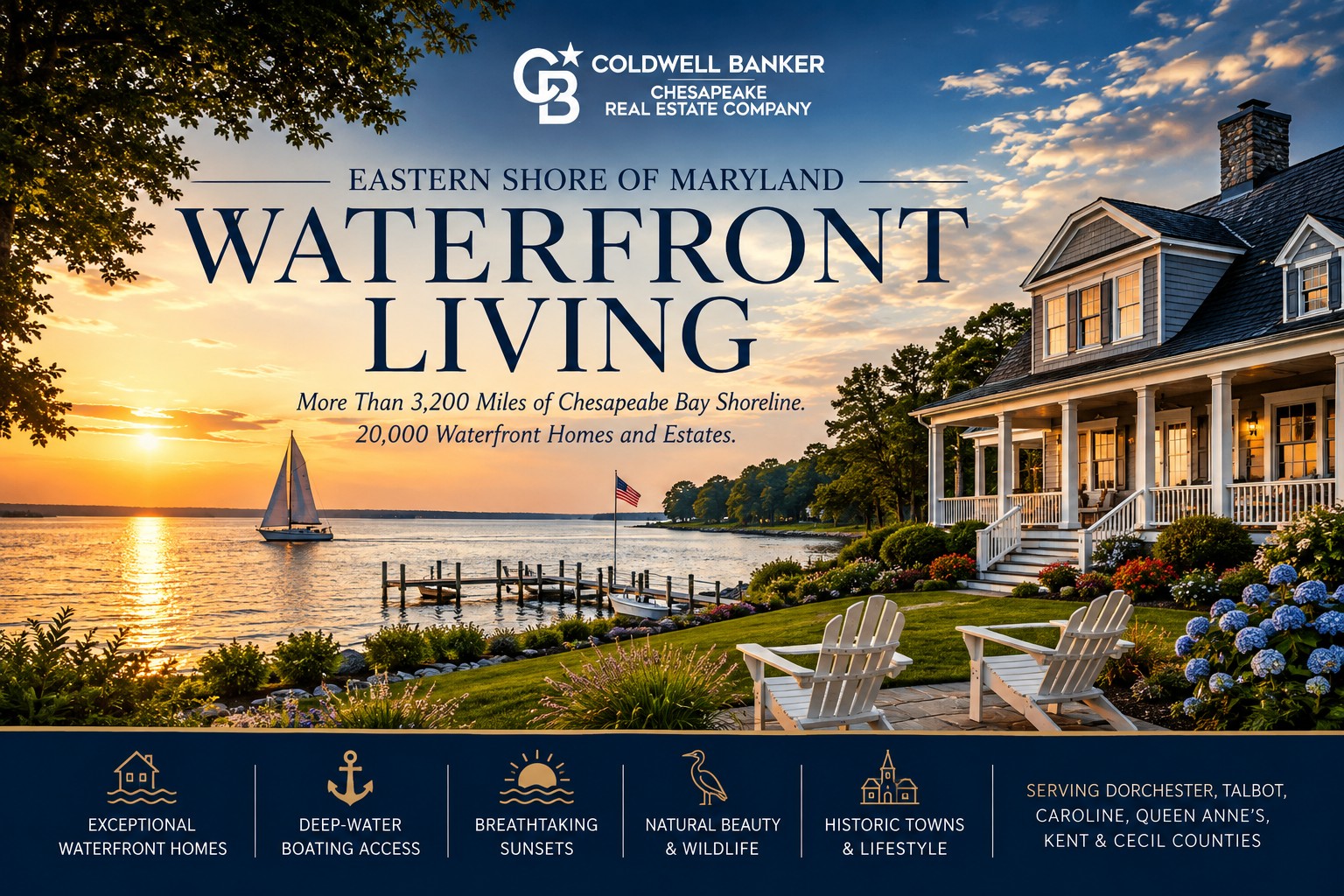
Why More Than 3,200 Miles of Chesapeake Bay Shoreline Creates One of America’s Greatest Waterfront Real Estate Markets (A Buyer & Sellers Guide)
By Hugh M. Smith, Broker
There are waterfront communities—and then there is Maryland’s Eastern Shore.
Stretching across Dorchester, Talbot, Caroline, Queen Anne’s, Kent, and Cecil Counties,
this remarkable region contains more than 3,200 miles of Chesapeake Bay shoreline and tidal tributaries.
It is one of the most extensive concentrations of navigable waterfront in the United States.
These six counties are estimated to contain approximately 20,000 waterfront homes, cottages, farms, and estates,
ranging from modest village residences to some of the Mid-Atlantic’s most prestigious waterfront properties.
The six counties served by Coldwell Banker Chesapeake Real Estate contain more than 3,200 miles of Chesapeake Bay shoreline—roughly
the equivalent of driving from New York City to Los Angeles without ever leaving the waterfront.
These shoreline and property figures are regional estimates. Exact totals depend on how waterfront property and tidal shoreline are defined.
How Much Waterfront Does Maryland’s Eastern Shore Have?
To put the region’s more than 3,200 miles of shoreline into perspective, these six counties have:
- Nearly as much shoreline as the traditional coastline measurement of California’s Pacific coast.
- Approximately eight times the shoreline of Rhode Island.
- Nearly twice the Atlantic shoreline of Massachusetts.
- One of the densest concentrations of tidal and navigable waterfront in North America.
These comparisons are approximate because coastline totals can vary significantly depending on the measurement method used.
Why Chesapeake Bay Waterfront Is Different
Unlike a relatively straight ocean coastline, the Chesapeake Bay shoreline is extraordinarily intricate—or
crenellated—with countless waterways and protected natural features.
The Eastern Shore landscape is shaped by:
- Tidal rivers
- Protected coves
- Creeks
- Marshes
- Peninsulas
- Islands
This unique geography creates an enormous variety of waterfront properties. Some homes offer direct Chesapeake Bay frontage and
expansive western views. Others provide protected docks on quiet creeks, deep-water access on major rivers, or panoramic views of
marshes and wildlife habitat.
No two Eastern Shore waterfront properties are exactly alike.
How Much Does an Eastern Shore Waterfront Home Cost?
The value of waterfront real estate varies substantially by location, water access, elevation, orientation, acreage, improvements,
shoreline condition, and property type.
A useful regional estimate for the average sale price of a Chesapeake Bay waterfront home or estate on Maryland’s Eastern Shore is
approximately $1.25 million. However, individual properties may sell well below or far above that amount.
| County | Typical Waterfront Value Range |
|---|---|
| Talbot County | $1.5 million–$2.0 million |
| Queen Anne’s County | $1.1 million–$1.5 million |
| Kent County | $900,000–$1.4 million |
| Dorchester County | $700,000–$1.2 million |
| Cecil County | $700,000–$1.1 million |
| Caroline County | $500,000–$800,000 |
These ranges are estimates intended to illustrate regional differences. They are not substitutes for a current comparative market
analysis using recent waterfront sales.
Location, Location, Location
Location remains one of the most important considerations when buying waterfront real estate on Maryland’s Eastern Shore.
Waterfront communities near the Chesapeake Bay Bridge and Maryland Route 301 have traditionally appealed to buyers from Washington,
D.C., Annapolis, Baltimore, and Northern Virginia because of their proximity to the metropolitan region.
The rapid growth of remote and hybrid work has expanded many buyers’ searches. More purchasers are now considering properties in both
Talbot and Kent Counties, as well as farther south in Dorchester County and farther north in Cecil County.
Kent and Cecil Counties—including Chestertown, Galena, and Chesapeake City—have traditionally attracted buyers from
Philadelphia, Wilmington, New Jersey, and the surrounding region. These areas are also becoming increasingly popular with buyers from
Washington and the Capital Beltway.
A waterfront real estate professional who understands the market from Dorchester County to Cecil County can help buyers compare travel
times, community character, boating opportunities, water conditions, property values, and long-term ownership costs.
Waterfront Property Types and Architecture
The Eastern Shore waterfront market includes an unusually broad range of properties:
- Modest river cottages
- Village homes with water access
- Deep-water boating properties
- Contemporary waterfront residences
- Historic Colonial and Federal homes
- Waterfront farms
- Equestrian and sporting estates
- Family compounds
- Luxury and trophy Chesapeake Bay estates
Each property type comes with different maintenance obligations, insurance considerations, improvement restrictions, and operating costs.
A waterfront cottage on a quarter-acre village lot is a very different ownership experience from a 500-acre farm or a 1,000-acre peninsula.
Why Waterfront Orientation Matters
Orientation is one of the most important—and frequently overlooked—characteristics of a waterfront property.
Prevailing summer breezes on the Eastern Shore often come from the southwest. The region’s celebrated Chesapeake Bay sunsets are also
generally visible to the west and southwest, depending on the season and location.
Winter nor’easters and some severe weather approach from the north or northeast. Historically, builders understood these natural
conditions. Many of the region’s finest older homes were positioned to capture cooling breezes while remaining set back from exposed
shorelines.
Waterfront homes and estates with desirable west or southwest exposure can command a premium because they offer attractive sunsets,
comfortable outdoor living, and broad water views.
Choosing the Right Property Size
Eastern Shore waterfront homes and estates come in nearly every size—from quarter-acre village cottages to expansive farms and historic
peninsula estates containing hundreds of acres.
Prospective buyers should evaluate more than the purchase price. Larger waterfront properties may require substantial ongoing investment in:
- Landscaping and lawn care
- Farm, forest, or habitat management
- Private roads and driveways
- Docks, piers, boat lifts, and marine structures
- Shoreline stabilization
- Outbuildings, tenant houses, and guest residences
- Septic, well, drainage, and stormwater systems
Some owners maintain their own properties. Larger estates may employ contractors, caretakers, farm managers, or year-round staff.
Understanding the full cost of ownership is essential before making an offer.
Water Depth and Boating Access
Water depth remains important, but its value depends on how the buyer intends to use the property.
Consider the following questions:
- Are you a sailor who requires deep water and sufficient mast clearance?
- Do you own an outboard-powered boat that can operate in shallower water?
- Will you use the property primarily for kayaking, paddleboarding, fishing, or wildlife observation?
- Do you need protected dockage, or are open-water views more important?
Chesapeake Bay properties often provide dramatic views but may be relatively shallow near the shoreline and more exposed to wind and waves.
Naturally deeper water is frequently found along major rivers and selected creeks, including areas such as the Wye River and Island Creek.
Water depth can change because of tides, storms, shoaling, sediment, drought, dredging, and seasonal conditions. Buyers should not rely
solely on a listing description. When water depth is critical, it should be independently measured and evaluated with the intended vessel
in mind.
Shoreline Type, Elevation, and Erosion
The shoreline of the Chesapeake Bay and its tidal tributaries varies greatly in composition and elevation.
Dorchester County contains extensive low-lying marshes and tidal landscapes. Moving north along the Eastern Shore, elevations generally
increase, with portions of Cecil County characterized by higher banks and more elevated waterfront.
Between those two extremes are sandy beaches, wooded banks, marsh edges, stone revetments, bulkheads, natural shorelines, and living shorelines.
One constant throughout the region is erosion. Prevailing winds generate “fetch”—the distance wind travels across open water—which creates
waves that can gradually wear away an unprotected shoreline.
Common Shoreline Stabilization Methods
- Riprap: Large stone placed along the shoreline to absorb wave energy and reduce erosion.
- Bulkheading: A vertical wall, commonly constructed from timber, vinyl, steel, or other materials.
- Stone revetments: Sloped stone structures designed to protect an eroding bank.
- Living shorelines: Natural or nature-based systems using native plants, sand, coir logs, oyster structures, and related materials.
Living shorelines can preserve habitat while reducing erosion, but they may not be suitable for every property, especially where wave
energy, water depth, navigation, or existing conditions require another approach.
Shoreline work may require state, federal, and local permits. Buyers should investigate the condition, permitted status, maintenance
history, and replacement cost of existing shoreline improvements.
Maryland Chesapeake Bay Critical Area Regulations
Maryland enacted the Chesapeake Bay Critical Area Protection Act in 1984 in recognition that development near the Bay and its tidal
tributaries can affect water quality, natural resources, and wildlife habitat.
The Critical Area generally includes land within 1,000 feet of the Chesapeake Bay and its tidal tributaries. Local
jurisdictions administer Critical Area programs under state oversight.
Depending on the property, these rules may affect:
- New construction
- Additions and expansions
- Shoreline structures
- Tree and vegetation removal
- Lot coverage
- Subdivision and development rights
- The buffer near tidal waters, tidal wetlands, and tributary streams
- Mitigation and planting requirements
Buyers should not assume that an existing home can automatically be enlarged, rebuilt, relocated, or replaced with a larger residence.
The feasibility of future improvements should be investigated before the end of the inspection and feasibility period.
Other Waterfront Due-Diligence Considerations
A thorough waterfront property evaluation may include:
- Flood-zone designation and elevation
- Flood, wind, and homeowners insurance availability
- Dock and pier permits
- Recorded water-access rights
- Water depth and navigation routes
- Bridge and power-line clearances
- Shoreline erosion and stabilization permits
- Septic system location, condition, and reserve area
- Well location, yield, and water quality
- Wetlands, conservation easements, and forest restrictions
- Critical Area classification and buffer requirements
- Survey boundaries and mean high-water lines
- Maintenance costs for marine and shoreline improvements
Why Expert Waterfront Representation Matters
Buying a waterfront home or estate is fundamentally different from buying a conventional residential property.
Online portals, automated valuations, and artificial intelligence may help buyers identify listings, but they cannot replace experienced
local judgment. An algorithm cannot stand on a dock, evaluate an eroding shoreline, navigate a creek, recognize a difficult exposure,
interpret a property’s physical setting, or understand how local regulations may affect a buyer’s plans.
Experienced waterfront representation can help buyers evaluate the relationship between a property’s price and its:
- Location
- Water depth
- Orientation
- Elevation
- Shoreline condition
- Dockage
- Acreage
- Architecture
- Regulatory limitations
- Long-term maintenance requirements
For real estate agents, developing genuine waterfront expertise is equally valuable. Buyers expect their representative to understand
the land, the water, the regulations, and the practical realities of waterfront ownership.
Find Your Place on Maryland’s Eastern Shore
Few regions offer the range of waterfront lifestyles found on Maryland’s Eastern Shore.
Buyers can choose a quiet river cottage, a deep-water boating retreat, a historic estate, a waterfront farm, a family compound, or a
trophy Chesapeake Bay residence—all within reach of Washington, Baltimore, Annapolis, Philadelphia, Wilmington, and New York.
Finding the right waterfront property is about much more than finding a beautiful view. It requires an understanding of the market,
shoreline, water access, regulations, property condition, and total cost of ownership.
Your waterfront dream deserves representation from a real estate professional who truly knows the waterfront.
Buying or Selling Eastern Shore Waterfront Property?
Coldwell Banker Chesapeake Real Estate serves waterfront buyers, sellers, and real estate professionals throughout Dorchester,
Talbot, Caroline, Queen Anne’s, Kent, and Cecil Counties.
Connect with a Coldwell Banker Chesapeake Real Estate professional to explore Chesapeake Bay waterfront homes, cottages, farms,
and estates across Maryland’s Eastern Shore.
About the Author
Hugh M. Smith is the Broker and Principal of Coldwell Banker Chesapeake Real Estate and a recognized authority on waterfront real estate along Maryland’s Eastern Shore. With more than 40 years of experience, he specializes in Chesapeake Bay waterfront homes, historic properties, farms, luxury estates, and commercial real estate throughout Dorchester, Talbot, Caroline, Queen Anne’s, Kent, and Cecil Counties.
A fifth-generation Eastern Shore resident, Hugh combines deep local knowledge with innovative real estate marketing to help buyers, sellers, and fellow REALTORS® navigate the unique opportunities and complexities of waterfront ownership. Through the Coldwell Banker Chesapeake Real Estate blog, he shares market insights, buying advice, and practical guidance on Chesapeake Bay waterfront living.
Editorial note: Shoreline totals, waterfront property counts, average prices, and county value ranges presented in
this article are approximate estimates intended for general market context. They should not be represented as official government,
tax-assessment, or MLS statistics without independent verification. Real estate prices and regulations change over time. Buyers should
consult qualified real estate, legal, environmental, marine, insurance, and permitting professionals regarding a specific property.
