
 Facebook
 X
 Pinterest
 Copy Link

Maryland’s Eastern Shore Housing Market: More Inventory, Fewer Buyers, and a Market in Transition
A look at October’s housing statistics, national real estate trends, and what buyers and sellers should expect as 2026 comes to a close.
Coldwell Banker Chesapeake Real Estate Company | Market Analysis Curated by Hugh M. Smith, Broker/Owner
The housing market is changing, and October’s numbers make that increasingly clear.
Across Maryland’s Eastern Shore, buyers are taking a more cautious approach, homes are spending longer on the market, and available inventory continues to grow. But while the pace of activity has slowed, the market is not standing still.
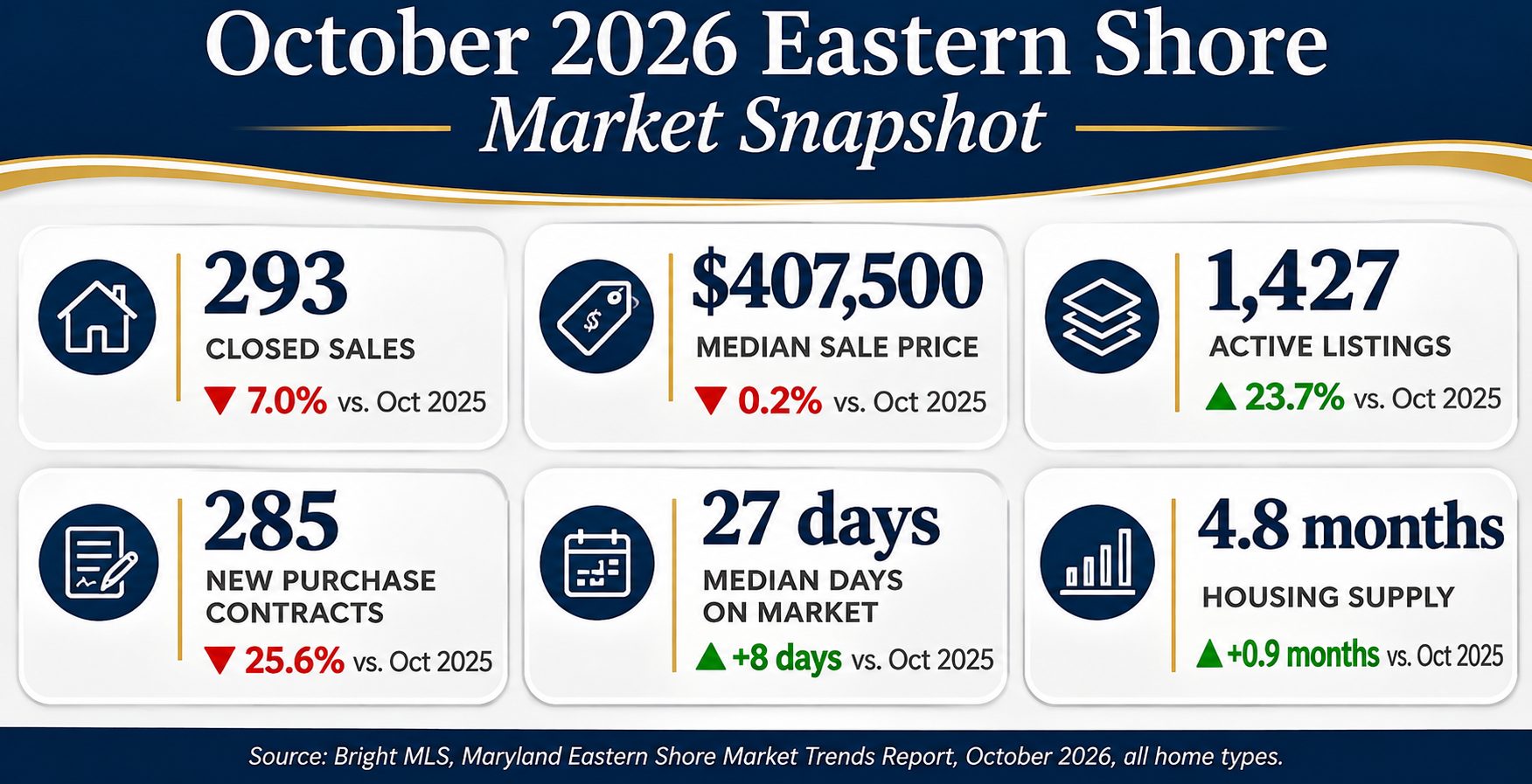
According to the October 2026 Bright MLS Market Trends Report, 293 homes sold across the region, with a median sale price of $407,500. Meanwhile, active listings climbed nearly 24% compared with October 2025.
The most revealing statistic may be the number of new purchase contracts: just 285 homes went under contract in October, a 25.6% decline from the same month last year.
What does this mean for homeowners, buyers, and sellers throughout Cecil, Kent, Queen Anne’s, Caroline, Talbot, and Dorchester counties?
This month’s Market Pulse examines the numbers, explores national housing trends, and considers what lies ahead for Maryland’s Eastern Shore.
National Housing Market: Affordability Is Reshaping Buyer Behavior
October marked another turning point for the national housing market.
According to Redfin’s November 10, 2026 report, the median U.S. home-sale price declined 0.4% year over year to $388,634. It was the first annual decline in more than three years.
At the same time, mortgage rates averaged approximately 7.33% during October, placing additional pressure on purchasing power.
The result? Buyers are increasingly selective, and sellers are facing greater competition.
Redfin also reported that 61% of homes sold nationally in October closed below their original asking prices, while 36% of completed sales involved at least one price reduction.
These trends do not necessarily indicate a housing market collapse. Instead, they suggest a market adjusting to affordability constraints and a growing supply of available homes.
What Inman Is Seeing
Industry reporting from Inman reinforces this changing outlook.
An October survey of real estate professionals found that buyer pipelines were weakening and sellers were becoming more hesitant about listing their properties.
Inman’s October reporting also highlighted declining builder confidence, with new-home builders increasingly using price reductions and financing incentives to attract buyers.
These developments underscore a broader trend: housing demand remains sensitive to mortgage rates, economic confidence, and monthly ownership costs.
Compass and Robert Reffkin: Local Conditions Matter
Research from Compass International Holdings has emphasized the growing differences between regional housing markets.
While some communities continue experiencing strong demand and limited supply, others are seeing inventory accumulate as buyers delay decisions.
In Compass’s November 5 earnings announcement, founder and CEO Robert Reffkin acknowledged that the housing market had softened in recent weeks.
The larger lesson is that national statistics provide context, but local market conditions determine how those trends affect individual properties.
For Maryland’s Eastern Shore, that distinction is particularly important.
Maryland’s Eastern Shore: The Gap Between Buyers and Sellers Is Widening
The October Bright MLS report reveals a market experiencing two very different trends.
Sellers continued bringing homes to market at nearly the same pace as last year. October recorded 413 new listings, identical to October 2025.
Buyers, however, were significantly less active.
New purchase contracts declined from 383 in October 2025 to 285 in October 2026.
That represents 98 fewer newly signed contracts, a 25.6% decline.
The number of home showings also decreased, falling 11.1% year over year to 2,864.
This combination suggests that fewer buyers are actively pursuing homes, even as sellers continue adding properties to the market.
More Homes Are Available
Active listings reached 1,427 at the end of October, compared with 1,154 a year earlier.
That’s an increase of 273 homes, or 23.7%.
The region also recorded 4.8 months of housing supply, up from 3.9 months in October 2025.
Traditionally, a market with approximately four to six months of inventory is considered relatively balanced, although conditions vary by location and price range.
For buyers, expanding inventory may create more choices and greater negotiating flexibility.
For sellers, it means standing out from competing properties is increasingly important.
Home Prices: Stability on the Surface, Change Beneath the Numbers
Despite slower activity, October’s median sale price remained relatively stable.
The median sold price was $407,500, compared with $408,500 in October 2025—a decrease of just 0.2%.
Year-to-date, the region’s median sale price was $399,900, up 1.2% from the same period in 2025.
This is an important distinction.
Although demand has weakened, the regional data does not indicate widespread or dramatic price declines.
However, median prices alone do not tell the complete story. Changes in the types, locations, and price ranges of properties sold can influence the regional median.
For homeowners, the value of a particular property depends on recent comparable sales, condition, location, amenities, and current competition.
Buyers Are Negotiating, but Sellers Are Still Closing Deals
The average sale-to-original-list-price ratio reached 94.9% in October.
That means homes sold for approximately 94.9% of their original asking prices, on average.
This measure improved slightly from 94.3% in October 2025.
It is important to note that this statistic compares sale prices with original asking prices, not necessarily the final advertised prices after reductions.
The takeaway is not that every seller must discount their home. Rather, the relationship between asking prices and completed sales reinforces the importance of understanding today’s market.
Homes Are Taking Longer to Sell
October’s median days on market reached 27 days, compared with 19 days one year earlier.
That’s an eight-day increase, or approximately 42%.
Longer marketing times can indicate that buyers are taking more time to evaluate properties, compare options, and negotiate.
For sellers, this reinforces the importance of making a strong first impression.
Professional photography, competitive pricing, accurate descriptions, and thoughtful property preparation can help position a home effectively.
Properties requiring substantial repairs or carrying unrealistic asking prices may face additional challenges.
What October’s Market Means for Eastern Shore Buyers
For buyers who have been waiting for greater selection and less competition, the changing market may present opportunities.
With 1,427 active listings across the region, buyers have more properties to consider than they did a year ago.
A slower pace of activity may also provide additional time to evaluate homes, review inspection findings, and discuss financing options.
However, mortgage rates remain a major affordability consideration.
Buyers should focus on:
- Understanding their total monthly housing payment, including taxes and insurance.
- Obtaining current mortgage preapproval.
- Comparing recent closed sales with competing listings.
- Evaluating property condition and potential repair costs.
- Reviewing flood zones, insurance, wells, septic systems, and waterfront-related requirements when applicable.
- Negotiating based on property-specific circumstances rather than national headlines.
The goal should not simply be finding a lower asking price. It should be purchasing a home that fits both long-term needs and financial circumstances.
What October’s Market Means for Eastern Shore Sellers
For homeowners considering a sale, October’s statistics highlight the importance of preparation and realistic expectations.
With more homes available and fewer buyers entering contracts, pricing strategy has become increasingly important.
Price for Today’s Market, Not Yesterday’s
A home should be priced using current comparable sales and competing inventory.
An asking price based solely on peak-market expectations may discourage buyers before they schedule a showing.
Presentation Matters
Professional photography, strong property descriptions, digital marketing, and appropriate repairs can help distinguish a property.
Sellers should consider addressing visible maintenance concerns and preparing their homes before entering the market.
Coldwell Banker Chesapeake’s Market Ready Concierge resources may help eligible sellers explore preparation options as part of their marketing strategy.
Understand the Competition
An effective listing strategy should consider not only recently sold properties but also homes currently competing for buyer attention.
With inventory increasing, sellers benefit from understanding how their property compares in price, condition, location, and amenities.
Luxury and Waterfront Real Estate: A Different Market Dynamic
Maryland’s Eastern Shore is home to distinctive waterfront estates, historic properties, farms, and luxury residences.
These properties often require more specialized market analysis than traditional residential homes.
Water depth, shoreline condition, acreage, conservation restrictions, property improvements, and permitted uses can all influence value.
Research from PropertyShark’s October 2026 luxury housing coverage demonstrates how differently high-end markets can behave across the country. Its analysis identified record pricing in several affluent ZIP codes, even as broader housing markets experienced affordability pressures.
However, these national luxury findings do not establish local Eastern Shore luxury price trends.
For sellers of waterfront and high-end properties in communities such as St. Michaels, Oxford, Easton, Chestertown, Rock Hall, and Kent Island, a property-specific market analysis remains essential.
What to Expect from Maryland’s Eastern Shore Housing Market in Late 2026 and Early 2027
As the year draws to a close, several trends deserve attention.
1. Buyer demand will remain a key indicator.
October’s 25.6% decline in new purchase contracts suggests that affordability and consumer confidence are influencing purchasing decisions.
If contract activity remains subdued, inventory could continue accumulating.
2. Inventory may create additional negotiating opportunities.
With active listings up nearly 24%, buyers may find more opportunities to compare homes and negotiate terms.
However, the amount of competition will continue to vary by property type and location.
3. Sellers will need to adapt to changing expectations.
Strategic pricing, professional marketing, and property preparation may become increasingly important as buyers gain more choices.
4. Mortgage rates will continue influencing activity.
Any meaningful improvement in borrowing costs could encourage some buyers to return, while persistently elevated rates may continue limiting purchasing power.
5. Local market knowledge will remain essential.
A waterfront estate in Talbot County, a historic home in Chestertown, and a residential property in Caroline County may experience very different buyer demand and marketing timelines.
The regional market provides an important overview, but individual real estate decisions require a more detailed understanding of local conditions.
Looking Toward Spring 2027: Is Now the Time to Prepare?
For homeowners considering a spring sale, November and December can provide an opportunity to begin planning.
Reviewing property condition, scheduling necessary repairs, researching comparable sales, and developing a marketing strategy before the spring listing season can help sellers make more informed decisions.
Preparation may include professional inspections, maintenance, landscaping, updated photography, and a review of competing properties.
The right timing will depend on individual goals, property characteristics, and local market conditions.
Rather than trying to predict exactly where prices or mortgage rates will move, buyers and sellers can benefit from understanding the options available today.
Frequently Asked Questions
Is Maryland’s Eastern Shore becoming a buyer’s market?
October’s 4.8 months of housing supply suggests a market approaching balance. Rising inventory and declining purchase contracts may create greater negotiating opportunities for buyers, although conditions vary by community and property type.
What was the median home sale price in October 2026?
According to Bright MLS, the median sale price across Maryland’s Eastern Shore was $407,500, down 0.2% from October 2025.
How many homes sold on Maryland’s Eastern Shore in October?
A total of 293 homes closed during October 2026, a 7.0% decline from the same month last year.
Are homes taking longer to sell?
Yes. The median time on market increased from 19 days in October 2025 to 27 days in October 2026.
Is now a good time to buy a home on Maryland’s Eastern Shore?
For qualified buyers, additional inventory and reduced competition may create opportunities. However, mortgage rates, ownership costs, property condition, and personal financial circumstances should guide the decision.
Should I wait until spring 2027 to sell?
There is no universal answer. Spring may bring different levels of buyer activity and competing inventory, but it does not guarantee a higher sale price. A local comparative market analysis can help determine the best strategy.
Local Expertise Matters in a Changing Market
National housing trends may influence the direction of the real estate market, but every community—and every property—has its own story.
At Coldwell Banker Chesapeake Real Estate Company, our professionals combine local knowledge, current market data, and comprehensive marketing resources to help buyers and sellers make informed decisions.
Whether you’re considering a waterfront property, selling a historic home, relocating to Maryland’s Eastern Shore, or preparing for your next move, understanding your local market is the first step.
Your Home. Your Future. Our Expertise.
Visit Coldwell Banker Chesapeake Real Estate Company to explore available properties and connect with a local real estate professional.
About Market Pulse
Market Pulse is a monthly real estate market report curated by Hugh M. Smith, Broker/Owner of Coldwell Banker Chesapeake Real Estate Company.
The series combines local Bright MLS statistics, national housing research, and industry reporting to provide insights for buyers, sellers, homeowners, and real estate professionals throughout Maryland’s Eastern Shore.
Data note: Local statistics are from the Bright MLS Maryland Eastern Shore Market Trends Report, October 2026, all home types. Information is deemed reliable but not guaranteed. National statistics use different reporting methods and geographic coverage. This article is informational and does not constitute financial, legal, or lending advice.
Research sources for the October article.
- Redfin — October Home Prices Decline for First Time in Three Years (November 10, 2026). Redfin Real Estate News
- Inman — Home Sellers Recoil as Rate Lock-In Deepens (November 2, 2026). Inman Real Estate News
- Inman — Builder Confidence Hits 14-Year Low (October 19, 2026). Inman Real Estate News
- Compass International Holdings — October Economic Research (October 28, 2026). Compass
- Compass — Robert Reffkin’s November 2026 Market Commentary. Compass
- PropertyShark — October 2026 Real Estate Research. PropertyShark
- Realtor.com — October Housing Market Report (November 4, 2026). Realtor
