
 Facebook
 X
 Pinterest
 Copy Link
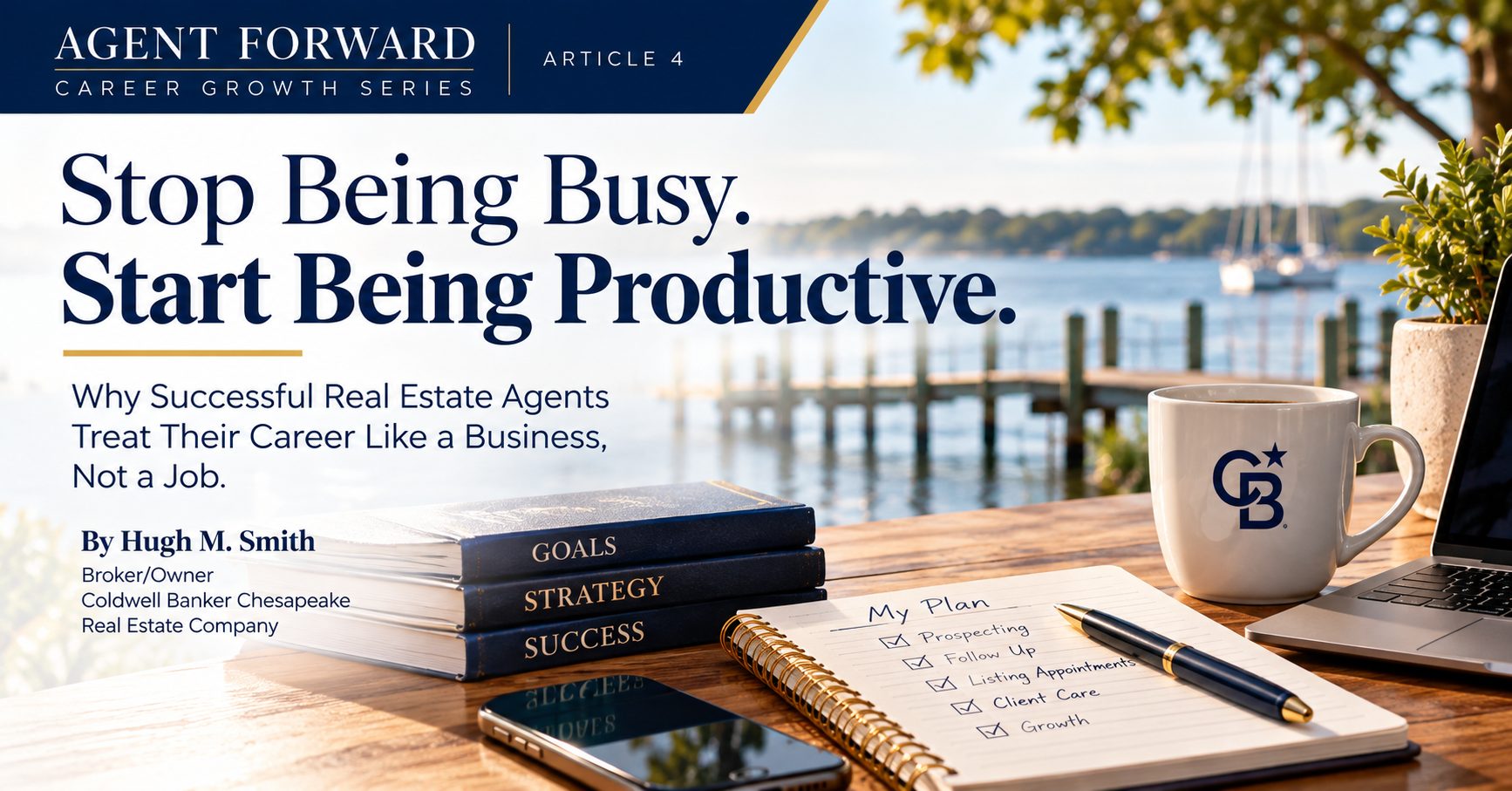
Why Successful Real Estate Agents Treat Their Career Like a Business, Not a Job
By Hugh M. Smith, Broker/Owner
Coldwell Banker Chesapeake Real Estate Company
One of the most common things I hear from newer real estate agents is, “I’m working all the time, but I’m not making the money I expected.”
They attend training sessions. They post on social media. They show houses. They respond to emails, research properties, and spend countless hours trying to generate business.
They’re busy.
But being busy and being productive are two very different things.
After more than four decades in real estate, I’ve learned that the agents who build successful, profitable careers aren’t necessarily the ones who work the longest hours. They’re the ones who understand which activities actually generate business—and have the discipline to do those things consistently.
Real estate rewards productive activity, not simply activity.
For agents in their first three years, understanding that distinction can change the trajectory of an entire career.
You’re Not Just an Agent. You’re Running a Business.
When you become a licensed real estate agent, you gain the opportunity to build your own business.
But there’s something they don’t spend nearly enough time teaching in real estate school.
How to actually run one.
You may know how to prepare a contract, explain agency relationships, and navigate a transaction. Those are essential professional skills.
But do you know your cost of doing business? How many appointments you need each month? How many conversations typically lead to a listing? How much income you need to generate to reach your financial goals?
These are business questions, not licensing questions.
And they’re questions every agent should be able to answer.
The sooner you begin thinking like a business owner, the sooner you can stop operating from one transaction to the next.
The Difference Between Dollar-Productive Activities and Busywork
Not all real estate activities contribute equally to your success.
Consider two agents.
Agent A spends the morning designing social media graphics, checking email, scrolling through new listings, and adjusting a marketing flyer.
Agent B spends the morning calling past clients, following up with potential sellers, scheduling listing appointments, and reconnecting with people in their database.
Both agents worked for three hours.
But which agent is more likely to generate future business?
Marketing, administration, education, and technology all have their place. They support your business.
However, they should never consistently replace the activities that create opportunities.
For most agents, those activities include:
- Having meaningful conversations with prospective buyers and sellers
- Following up with leads and past clients
- Asking for referrals
- Scheduling listing and buyer consultations
- Developing relationships within their communities
- Studying the market and identifying potential listing opportunities
- Negotiating and moving transactions toward successful closings
I encourage agents to ask themselves one simple question at the end of each day:
“What did I do today that will generate business 30, 60, or 90 days from now?”
If you can’t identify anything, it may be time to reconsider how you’re spending your working hours.
Want to read more: Busy but Broke: Where New Real Estate Agents Waste Their Time
Your Calendar Should Reflect Your Priorities
One of the greatest advantages of a real estate career is flexibility.
Ironically, that flexibility can also become one of the biggest obstacles to success.
Without structure, it’s easy to spend an entire day responding to whatever seems most urgent.
An email arrives. A client calls. Someone wants to see a property. A new social media trend catches your attention.
Before you know it, the day is over—and you haven’t contacted a single potential seller.
Successful agents learn to protect time for business development.
That might mean reserving the first 60 to 90 minutes of each workday for prospecting, database follow-up, and relationship-building.
The exact schedule matters less than the commitment.
Treat that appointment with your business as seriously as you would a listing presentation.
Because without future business, there won’t be many listing presentations to attend.
Want to read more, visit: Setting Up for Success
Know Your Numbers
You cannot manage what you don’t measure.
Yet many agents have only a vague understanding of their business performance.
They know how many homes they’ve sold, but they may not know what activities produced those sales.
Start tracking a few basic numbers:
- Meaningful conversations: How many potential clients and referral sources did you personally connect with?
- Appointments scheduled: How many buyer or seller consultations did those conversations produce?
- Listings taken: How many listing agreements did you secure?
- Transactions closed: How many sales resulted from your efforts?
- Business expenses: What did it actually cost to generate your income?
Over time, these numbers reveal patterns.
Perhaps you discover that personal referrals consistently produce stronger opportunities than purchased internet leads.
Or that your neighborhood marketing generates more listing appointments than your general social media posts.
Once you understand what works, you can invest more time and resources in those activities.
A productive real estate business is built on informed decisions, not assumptions.
Profit Matters More Than Production
Real estate agents love to talk about sales volume.
But sales volume doesn’t necessarily tell you how profitable an agent’s business is.
An agent who closes a large number of transactions while spending heavily on advertising, purchased leads, and other expenses may earn less than an agent who closes fewer transactions through a well-developed referral network.
Gross commission income is important.
Net income is what ultimately supports your life and your future.
As your business develops, pay attention to the relationship between your revenue and expenses.
Ask yourself:
- How much am I spending to acquire each client?
- Which marketing activities produce measurable results?
- Am I investing in tools that save time or simply adding expenses?
- Is my business becoming more efficient as I gain experience?
The objective isn’t simply to sell more homes.
It’s to build a business that becomes increasingly productive, profitable, and sustainable.
Use Technology to Buy Back Your Time
Artificial intelligence and modern CRM systems offer tremendous opportunities for agents who understand how to use them.
AI can help you prepare marketing materials, organize research, draft communications, develop content, and analyze information.
A well-maintained CRM can remind you when to follow up, track important conversations, and help ensure that valuable relationships don’t disappear into an overloaded inbox.
But technology should serve your business—not become another distraction.
I’ve seen agents spend hours experimenting with software while avoiding the very conversations that could generate their next transaction.
Use technology to reduce administrative work and improve your effectiveness.
Then reinvest the time you save into building relationships, gaining market knowledge, and serving clients.
The best technology doesn’t replace your personal value. It gives you more time to deliver it.
Remember that AI-generated information should always be checked for accuracy, confidentiality, and compliance before being used in client communications or marketing.
A Simple 90-Day Plan for Building Momentum
If you’re struggling to gain traction, you don’t necessarily need a complicated business plan.
Start with the next 90 days.
Step 1: Set a Measurable Goal
Decide how many appointments, listings, or transactions you want to generate during the next three months.
Make the goal realistic, but challenging enough to require consistent effort.
Step 2: Identify Your Best Sources of Business
Review your database, past clients, sphere of influence, community relationships, open-house opportunities, and existing leads.
Where are your strongest opportunities?
Step 3: Schedule Daily Business Development
Block time for prospecting and follow-up before the day becomes crowded with other responsibilities.
Step 4: Track Your Activities Weekly
Measure conversations, appointments, listings, and transactions. Look for patterns and make adjustments.
Step 5: Find Someone Who Will Hold You Accountable
A productive broker, coach, or mentor can help you recognize what is working, identify weaknesses, and stay focused on your goals.
Accountability isn’t about someone telling you what to do.
It’s about having someone invested enough in your success to challenge you to improve.
Not sure where to start with your business plan? Check out this article: 7 Steps to Writing a Real Estate Business Plan + Template
Your Brokerage Should Help You Build a Business
I’ve always believed that a brokerage should do more than provide a place to hang your license.
A good brokerage should help agents become better businesspeople.
That means providing guidance, training, marketing support, technology, and access to experienced professionals who understand how to build successful real estate careers.
It also means helping agents understand the economics of their business.
At Coldwell Banker Chesapeake, our goal is to help agents become more productive and build profitable businesses—not simply increase transaction counts.
For agents early in their careers, the right environment can make a meaningful difference.
Ask yourself whether you’re receiving the support you need to become more capable, more efficient, and more successful.
Because the value of a brokerage relationship should be measured by more than a commission split.
It should also be measured by how much better you’re becoming at your profession.
Final Thoughts: Build a Business That Works
Real estate offers extraordinary opportunities for people willing to learn, develop relationships, and work consistently toward meaningful goals.
But hard work without direction can become exhausting.
If you’re in your first three years of real estate, don’t confuse a full calendar with a growing business.
Protect time for the activities that generate income.
Build relationships that create future opportunities.
Know your numbers.
Control your expenses.
Use technology wisely.
And surround yourself with people who will help you grow.
The goal isn’t to become the busiest agent in your market. It’s to become one of the most productive, profitable, and trusted.
That’s how you build a real estate career that lasts.
Frequently Asked Questions
What are the most productive activities for a new real estate agent?
Activities that create or advance client relationships are generally the most valuable. These include prospecting, following up with leads, contacting past clients, asking for referrals, scheduling appointments, and developing local market expertise.
How many hours should a real estate agent spend prospecting?
There is no universal requirement. Newer agents may benefit from protecting 60 to 90 minutes each business day for prospecting and follow-up, then adjusting their schedule based on results and client responsibilities.
How can a real estate agent measure productivity?
Track meaningful conversations, appointments, listings taken, transactions closed, gross commission income, and business expenses. These measures help identify which activities produce results.
How can AI help real estate agents become more productive?
AI can assist with content development, research, administrative organization, and drafting communications. Agents should verify its output and use it to support—not replace—professional judgment and personal client relationships.
What should newer agents look for in a brokerage?
Look for accessible leadership, meaningful training, business planning assistance, marketing and technology support, mentorship, and an environment that encourages accountability and professional growth.
About the Author
Hugh M. Smith is the Broker/Owner of Coldwell Banker Chesapeake Real Estate Company. A licensed real estate broker since 1983, Hugh has spent more than four decades helping agents develop the skills, relationships, and business systems needed to build productive, profitable, and sustainable real estate careers.
Interested in Building a Stronger Real Estate Business?
Learn more about professional development and career opportunities with Coldwell Banker Chesapeake Real Estate Company.
