
 Facebook
 X
X
 Pinterest
 Copy Link
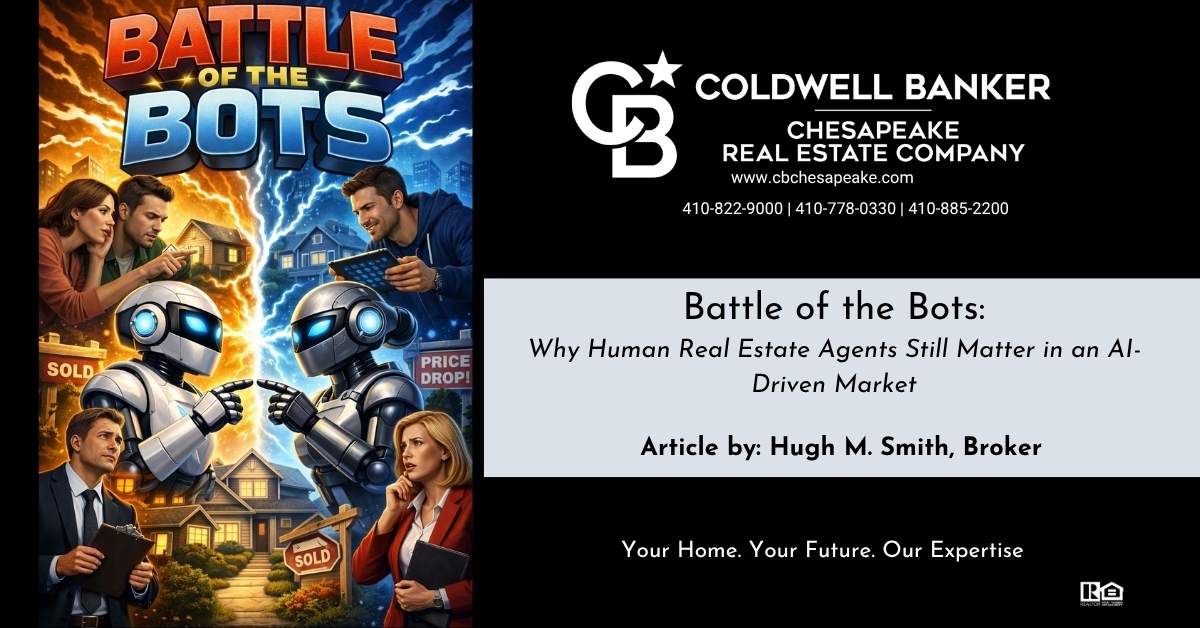
Why Human Real Estate Agents Still Matter in an AI-Driven Market
By Hugh M. Smith, Broker/Owner, Coldwell Banker Chesapeake Real Estate Company
We are standing at the edge of another transformative wave—one that feels both familiar and entirely new.
The real estate industry has weathered seismic shifts before: the rise of the internet, the explosion of listing portals, the digitization of contracts, and the emergence of mobile-first consumers. Each time, the same question surfaced:
Will this replace the real estate agent?
Now, that question has returned—louder, faster, and more complex.
Artificial Intelligence has entered the arena.
Buyers and sellers are adopting AI tools at a pace that, in many cases, outstrips adoption within the residential real estate industry itself. With a few keystrokes, consumers can estimate home values, analyze neighborhoods, draft contracts, and even simulate negotiation strategies. Information that once required years of experience—or at least a trusted advisor—is now instantly accessible.
It’s tempting to frame this moment as a showdown: human versus machine.
Agent versus algorithm.
Experience versus efficiency.
But the real story is far more nuanced.
This is not a battle to eliminate one side. It’s a moment that demands we understand how both can coexist—and how the winners will be those who learn to collaborate.
The Rise of the Empowered Consumer
Today’s buyers and sellers are more informed than ever before. AI has accelerated that trend dramatically.
A buyer can now:
- Analyze comparable sales within seconds
- Predict market trends using AI-driven forecasts
- Generate questions about inspections, financing, and valuation
- Explore neighborhoods through layers of data beyond traditional MLS insights
Sellers can:
- Estimate property value ranges using multiple models
- Optimize listing descriptions with AI-generated copy
- Evaluate timing strategies based on predictive analytics
- Model potential net proceeds under different scenarios
This is, in many ways, a positive evolution. An informed client is often a more confident client.
Conversations become more meaningful. Decisions can be made more efficiently. Transparency increases.
In its best form, AI enhances the client experience.
But there is another side to this coin.
When Information Becomes Interference
Access to information is not the same as understanding.
AI is exceptional at delivering logical, data-driven outputs. It synthesizes patterns, aggregates information,
and produces conclusions based on probabilities. But real estate transactions are rarely governed by logic alone.
They are influenced by:
- Emotions
- Timing pressures
- Human behavior
- Negotiation dynamics
- Personal motivations that never appear in a dataset
When clients rely too heavily on AI-generated conclusions—without context or professional interpretation—it can lead to second-guessing.
And second-guessing, at the wrong moment, can derail a transaction.
A buyer might submit an offer based on AI-derived pricing that looks “correct” on paper—but misses real-time competitive dynamics.
A seller might reject a strong offer because an AI tool suggests waiting—without understanding buyer sentiment in that specific moment.
The data isn’t necessarily wrong.
It’s incomplete.
The Strength of AI: Logic, Speed, and Consistency
Let’s be clear: AI is extraordinarily powerful.
It is:
- Fast
- Scalable
- Consistent
- Highly effective at pattern recognition
- Excellent in structured, rule-based environments
In real estate, this translates to:
- Pricing models
- Market trend analysis
- Document automation
- Lead qualification
- Transaction management systems
AI thrives in logical transactions—where inputs are clear and outputs can be calculated.
And in these areas, it will continue to outperform humans.
This is not a threat. It’s an opportunity.
Because it allows agents to spend less time on routine tasks—and more time where they create the greatest value.
The Human Advantage: What AI Cannot Replicate
Despite its capabilities, AI has fundamental limitations.
It does not possess:
- Emotional intelligence
- Intuition
- Creativity
- Imagination
- The ability to build and sustain relationships
These are not minor gaps. They are central to the real estate process.
Emotional Intelligence
Buying or selling a home is deeply personal. It often involves major life transitions—marriage, divorce, relocation,
financial stress, or loss.
AI cannot read hesitation in a client’s voice.
It cannot reassure a nervous seller.
It cannot guide someone through the emotional weight of leaving a home filled with memories.
Agents don’t just manage transactions—they manage emotions.
Intuition
Experienced agents develop instincts that go beyond data.
They can:
- Sense when a deal is about to fall apart
- Anticipate competing offers
- Read between the lines of a negotiation
- Adjust strategies in real time
This intuition is built through experience, not algorithms.
Innovation and Imagination
Every transaction presents unique challenges.
Financing issues arise. Inspections uncover unexpected problems. Negotiations stall.
AI can suggest solutions based on past patterns—but it cannot invent new strategies in the moment the way a skilled agent can.
Relationship Building
Real estate is, at its core, a relationship business.
Trust is built over time. Clients rely on advisors they believe in.
Deals often hinge on communication between people—not systems.
AI cannot nurture relationships. It cannot advocate with credibility rooted in trust.
And ultimately, people still want to work with people.
A Real-World Example: When Bots Start Negotiating
A powerful illustration of this shift is unfolding right now in a transaction near Chestertown, Maryland.
The seller—recently divorced—is understandably cautious and deeply distrustful. She relies almost entirely on email and text communication.
That alone creates a layer of separation. But something else has become clear.
She is using AI—specifically ChatGPT—to validate and challenge the advice she receives from her listing agent.
At one point, she asked:
“How do I respond to multiple offers?”
She then copied and pasted ChatGPT’s response directly into an email and sent it to her agent.
On the other side of the transaction, the buyer is doing something similar.
According to the buyer’s agent, his client is using Google’s Gemini to guide negotiation strategy—particularly around home inspection issues.
This includes generating responses and even requesting repair estimates based on inspection findings.
So here we have:
- A seller guided by one AI system
- A buyer guided by another
- Two experienced agents working to keep the deal together
Both parties want the same outcome:
The seller wants to sell.
The buyer wants to buy.
And yet, this transaction has come dangerously close to collapsing—multiple times.
Why?
Breakdown in Communication
Instead of conversation, there is copy-and-paste. Instead of dialogue, there are pre-generated responses.
The human connection—the ability to clarify, interpret, and adapt—is diminished.
Flawed or Generalized Information
AI often delivers answers based on national data or broad assumptions. Real estate, however, is hyper-local.
What works in one market may not apply in another—especially in a unique market like Maryland’s Eastern Shore.
Contradictory Guidance
Different AI platforms—or even different prompts—can produce conflicting advice.
This creates confusion, hesitation, and friction at critical decision points.
Erosion of Trust
When clients begin to rely more on AI than their agent, the advisory relationship weakens.
Without trust, even sound guidance can be ignored.
There’s an old adage in technology: “Garbage in, garbage out.”
AI can feel like a magic wand—but it is only as good as the prompts behind it.
And prompt creation is a skill—one most consumers are just beginning to develop.
In this case, the transaction has survived not because of AI—but because of experienced local agents who understand how to interpret, adapt, and guide.
The Complexity of Negotiation
Negotiation in real estate is not just about numbers.
It is layered, dynamic, and deeply human.
Successful negotiation requires:
- Reading personalities
- Understanding leverage beyond price
- Timing responses strategically
- Managing expectations and emotions
- Navigating incomplete information
AI can simulate negotiation scenarios. It can suggest tactics.
But it cannot sit in a tense moment and adjust to subtle cues.
It cannot build rapport with the opposing party.
It cannot create trust that leads to concessions.
This is where skilled agents create extraordinary value—and where AI reaches its limits.
Collaboration: The Winning Strategy
The future is not AI or agents.
It is AI and agents.
The best outcomes occur when:
- AI provides speed and data
- Clients bring curiosity and engagement
- Agents contribute judgment, experience, and strategy
This collaboration leads to better decisions, smoother transactions, and stronger results.
Imagine a client using AI to explore possibilities—and an agent refining those possibilities into a winning strategy.
That is not disruption.
That is evolution.
The Evolution of the Agent’s Value Proposition
AI is not eliminating the need for agents—it is redefining their role.
The most successful agents will:
- Embrace AI as a tool, not a threat
- Use technology to increase efficiency
- Focus on human-centered skills
- Position themselves as strategic advisors
The value proposition is shifting from:
Access to information
to
Interpretation, strategy, and execution
Because information is now everywhere.
Wisdom is not.
Conclusion: Not a Battle, But a Balance
“The Battle of the Bots” makes for a compelling headline.
But the reality is less about conflict—and more about balance.
AI brings speed, logic, and efficiency.
Agents bring empathy, intuition, and experience.
Clients benefit most when both work together.
Because while technology can transform how we buy and sell homes, it cannot replace why we do it.
Homes are not just transactions.
They are life transitions.
They are deeply human.
And guiding people through those moments requires more than data.
It requires understanding.
It requires trust.
It requires people.
In the end, the winners in this so-called battle won’t be the bots—or even the agents alone.
They will be those who understand that the real power lies in combining the best of both worlds.
Coldwell Banker Chesapeake Real Estate Company
Your Home. Your Future. Our Expertise.
